Verification
decided in shape, draft in detail (hashes use canonical form v0)
No implementation code gets written until its behaviour is defined. The source of truth is:
- Gherkin
.featurefiles describing behaviour in plain language - JSON test vectors generated from them: an initial state, plus per-client operation streams delivered late and out of order
One suite, every implementation
Section titled “One suite, every implementation”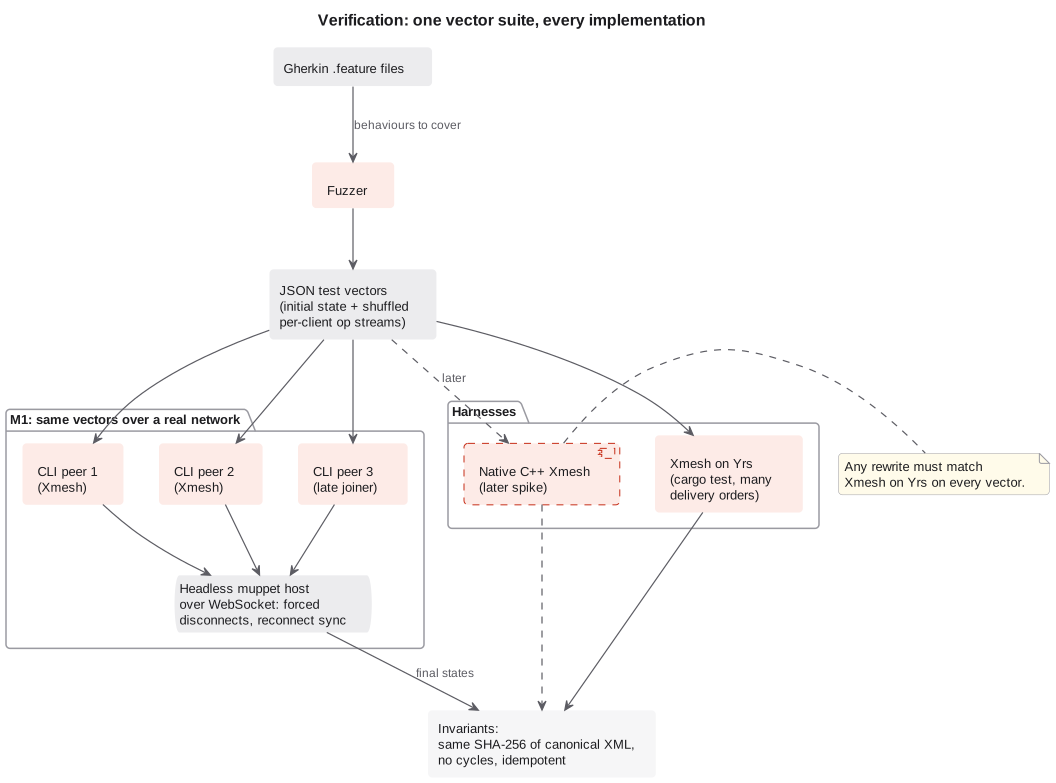
| Harness | Why it exists |
|---|---|
Xmesh on Yrs (cargo test) |
The implementation. Every vector is replayed in many delivery orders. |
| Native C++ Xmesh | Later spike. Held to the same vectors and cross-checked against Xmesh on Yrs. |
The pass conditions are invariants, checked on every run:
- Convergence: every delivery order ends with the same SHA-256 of the canonical XML.
- No cycles: the materialised tree is always a tree.
- Idempotence: delivering an operation twice changes nothing.
Vectors also pin down the session rules (decision 19):
- Fork after a deletion: a fork rebuilt from its snapshot still holds content deleted after the fork.
- ETag on delete: deleting a shape changes the snapshot hash.
- Refusal doesn’t stall: a refused session is never merged, and every admitted session keeps converging.
- Held dependencies: a session built on an unadmitted one is held back with it, with a defined error.
- Client ID reuse: a binding for a client ID already in the session’s history is rejected.
And the tree rules (decision 20):
- Moves never form cycles: concurrent moves that would make a cycle of two, three or more elements converge to the same tree in every delivery order.
- Same-spot inserts: two peers inserting at the same place get the same order on every peer.
- Deletion: a deleted element and its subtree leave the document; undo brings them back.
- Known gaps, as expected failures (moves in v1): an edit made during a move appears on the copy; two concurrent moves of one element leave one copy. These vectors are kept so the gaps stay visible, and pass once a tree layer of our own lands.
- Signatures: a challenge answer, binding or grant is rejected on a different host, for a different session, or under the wrong domain tag.
- Duplicate ids: two sessions creating the same
idmerge, converge, and flag the duplicate. - Mixed content, namespaces and every node kind:
<text>with interleaved<tspan>s,inkscape:andsodipodi:attributes, comments, processing instructions and CDATA all round-trip.
The fuzzer
Section titled “The fuzzer”The first task from the original handover, re-scoped to feed every harness. It generates:
- an initial SVG (a root
<svg>with one<g>layer) - randomised operations from several clients: inserting paths, updating attributes, moving nodes, adding comments
- one chronological stream per client, plus heavily delayed and shuffled delivery orders
Over a real network
Section titled “Over a real network”Milestone M1 runs the same vectors through three CLI peers (one a late joiner) and a headless muppet hosting the session, all embedding Xmesh, over WebSocket, including dropped connections and reconnect sync. Convergence then holds over a real, unreliable network, not just in a test process.